研究内容
π共役高分子の精密合成 Precise synthesis of π-conjugated polymers
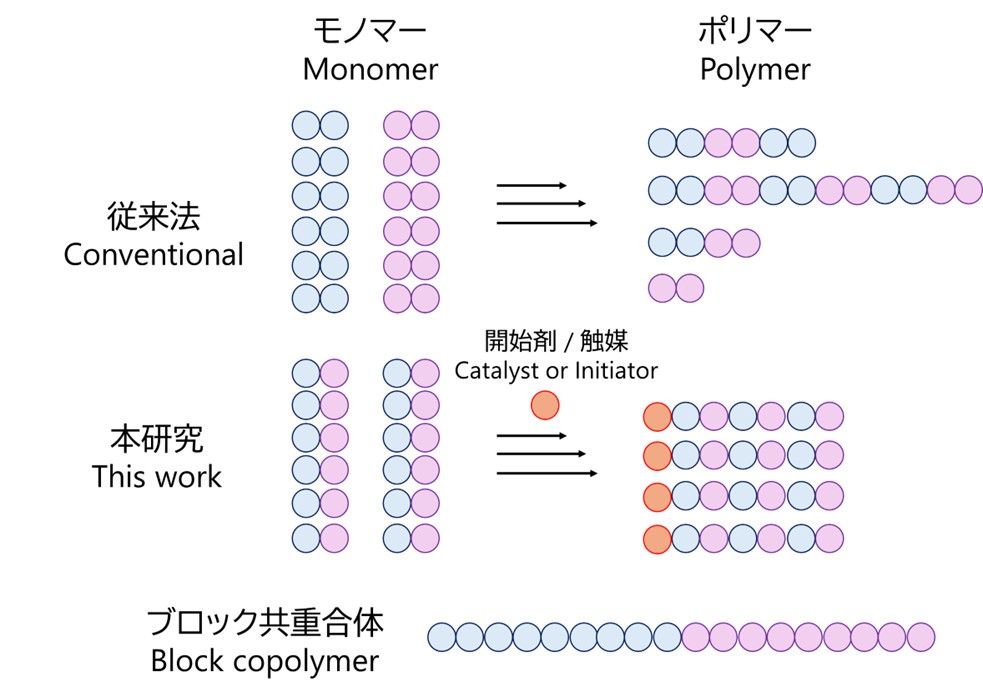
π共役高分子は、有機エレクトロニクス分野において中核的な役割を担う材料です。主鎖に共役した結合を有することでp軌道が非局在化し、導電性や半導体性を発現します。本研究室では、このような材料の精密設計と機能制御に関する研究を行っています。従来の重合法では、分子量制御や構造均一性に課題があり、材料特性のばらつきが問題となっていました。本研究室では、縮合的連鎖重合法を用いることで、これらの課題を克服し、分子構造を高精度に制御することを可能としています。さらに、ブロック共重合体として設計することで、ナノスケールでの自己組織化構造を形成させ、電荷輸送特性の向上や機械的特性の改善を実現しています。
π-Conjugated polymers play a central role in the field of organic electronics. The presence of conjugated bonds along the main chain enables delocalization of p-orbitals, resulting in electrical conductivity and semiconducting properties. In our laboratory, we focus on the precise design and functional control of such materials. Conventional polymerization methods often suffer from limitations in molecular weight control and structural uniformity, leading to variability in material properties. In our laboratory, these challenges are addressed by employing “condensative chain polymerization”, which enables precise control over primary structures of the generating polymers. Furthermore, by designing these materials as block copolymers, we induce nanoscale self-assembled structures, achieving enhanced charge transport properties as well as improved mechanical performance.
非等モル重縮合によるπ共役高分子の合成 Synthesis of π-conjugated polymers via nonstoichiometric polycondensation
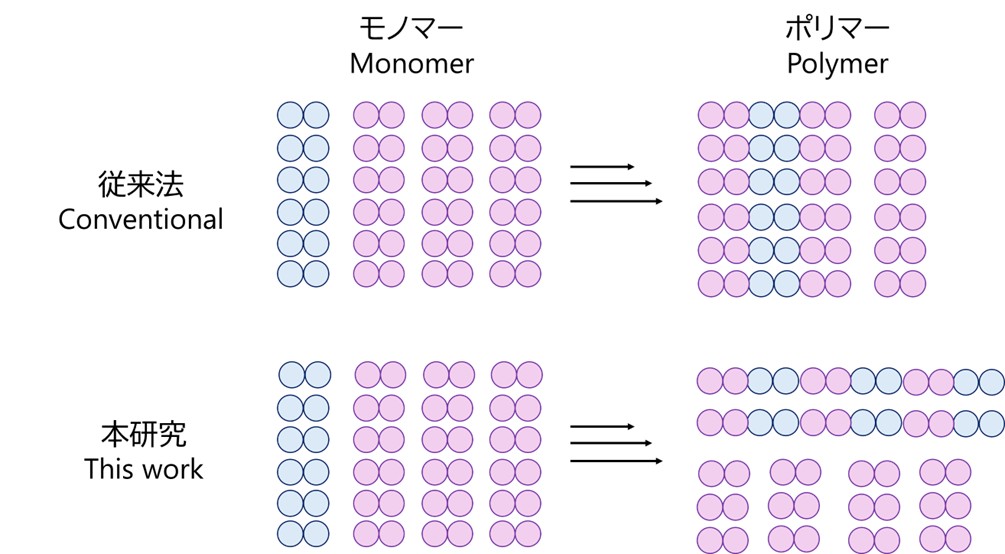
π共役高分子の合成では、一般に2種類の二官能性モノマーを用いた均一溶液中での重合が行われます。この場合、高分子量体を得るためには、モノマーの厳密な等モル比の制御が不可欠です。例えば、100量体以上のポリマーを得るためには、理論上、わずか2 mol%以内のモル比のズレしか許容されません。しかし、この理論は、モノマーの官能基の反応性が、モノマー自身と成長末端においてほぼ同一であるという前提に基づいています。我々は、この前提を意図的に崩すことで、非等モル条件下においても、従来の理論を大きく上回る分子量を有するπ共役高分子の合成に成功しました。本手法により、将来的には反応性の低いモノマーを過剰に用いることで重合速度を向上させつつ、高分子量体の合成が可能となり、新規π共役高分子材料の開発へとつながることが期待されます。
In the synthesis of π-conjugated polymers, polymerization is generally carried out in a homogeneous solution using two types of bifunctional monomers. In such systems, precise control of the equimolar ratio of the monomers is essential to obtain high-molecular-weight polymers. For example, to achieve polymers with a degree of polymerization exceeding 100, the theoretically allowable deviation in the molar ratio is within only about 2 mol%. However, this theory is based on the assumption that the reactivity of the functional groups is essentially identical between the monomers themselves and the growing chain ends. By intentionally breaking this assumption, we have succeeded in synthesizing π-conjugated polymers with molecular weights far exceeding those predicted by conventional theory, even under non-equimolar conditions. This method is expected to enable the use of an excess amount of less reactive monomers to enhance polymerization rates while still achieving high molecular weights, thereby opening new avenues for the development of novel π-conjugated polymer materials.
有機薄膜トランジスタ材料 Organic Thin-Film Transistors
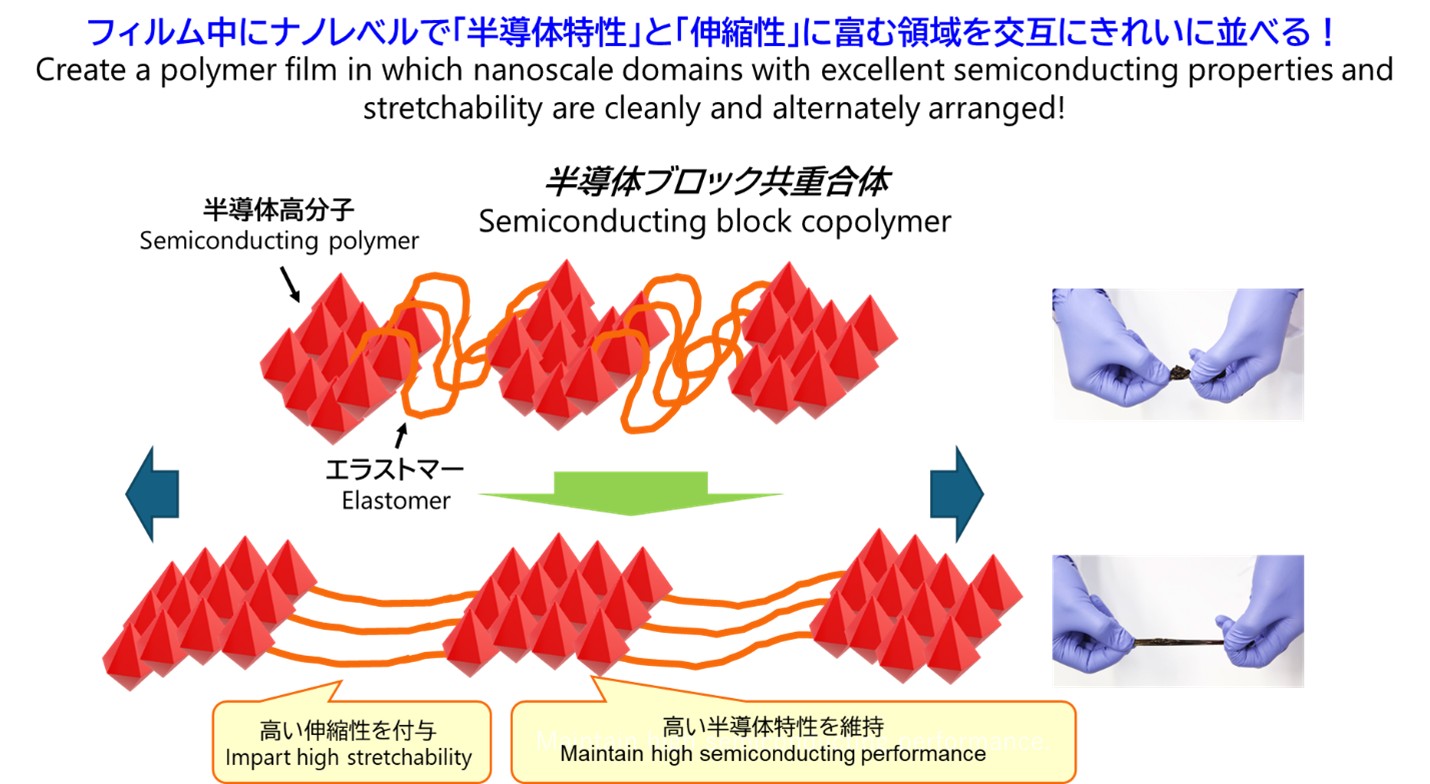
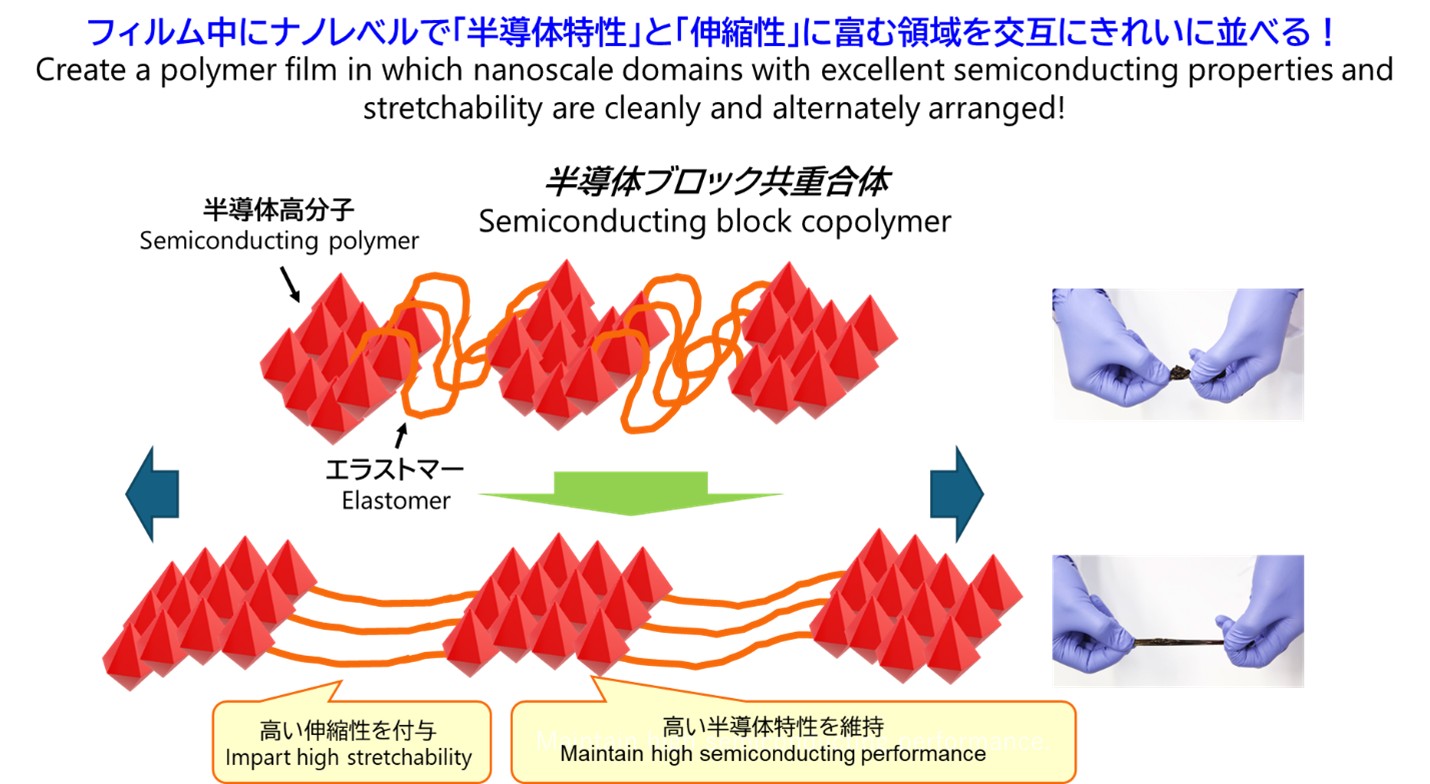
有機薄膜トランジスタ(Organic Thin-Film Transistor: OTFT)は、有機半導体材料を用いて電流を制御する電子デバイスであり、次世代のフレキシブルエレクトロニクスを支える重要な技術です。低温プロセスで作製できるため、プラスチックなどの柔軟な基板上にも形成可能で、軽量・曲げられるデバイスの実現に適しています。近年は材料設計や薄膜形成技術の進展により性能が大きく向上し、フレキシブルディスプレイやセンサ、ウェアラブル機器などへの応用が期待されています。また、印刷技術を活用した低コスト・大面積製造が可能である点も大きな特徴です。将来的に、有機薄膜トランジスタ材料への伸縮性付与が期待されますが、半導体特性と伸縮性にはトレードオフの関係があります。これを解消するため、我々独自の精密合成手法を活かし、半導体ブロック共重合体からなるエラストマー材料を新規開発しました。半導体特性の高いポリマー鎖と伸縮性に富むポリマー鎖を分子レベルで交互に結合させることで、半導体特性を維持したまま高い伸縮性を付与することに成功しました。
Organic Thin-Film Transistors (OTFTs) are electronic devices that control electrical current using organic semiconductor materials and are considered a key technology for next-generation flexible electronics. Because they can be fabricated through low-temperature processes, OTFTs can be formed on flexible substrates such as plastics, making them well-suited for lightweight and bendable devices. In recent years, significant advances in material design and thin-film fabrication techniques have greatly improved device performance, leading to promising applications in flexible displays, sensors, and wearable devices. Another notable advantage is their compatibility with printing technologies, enabling low-cost and large-area manufacturing. Looking ahead, imparting stretchability to OTFT materials is highly desirable; however, there is generally a trade-off between semiconducting performance and mechanical stretchability. To address this challenge, we have developed a novel elastomeric material composed of semiconducting block copolymers by leveraging our unique precision polymerization techniques. By alternately connecting polymer chains with high semiconducting properties and those with excellent stretchability at the molecular level, we successfully achieved high stretchability while maintaining excellent semiconducting performance.
有機熱電変換材料 Organic Thermoelectric Materials
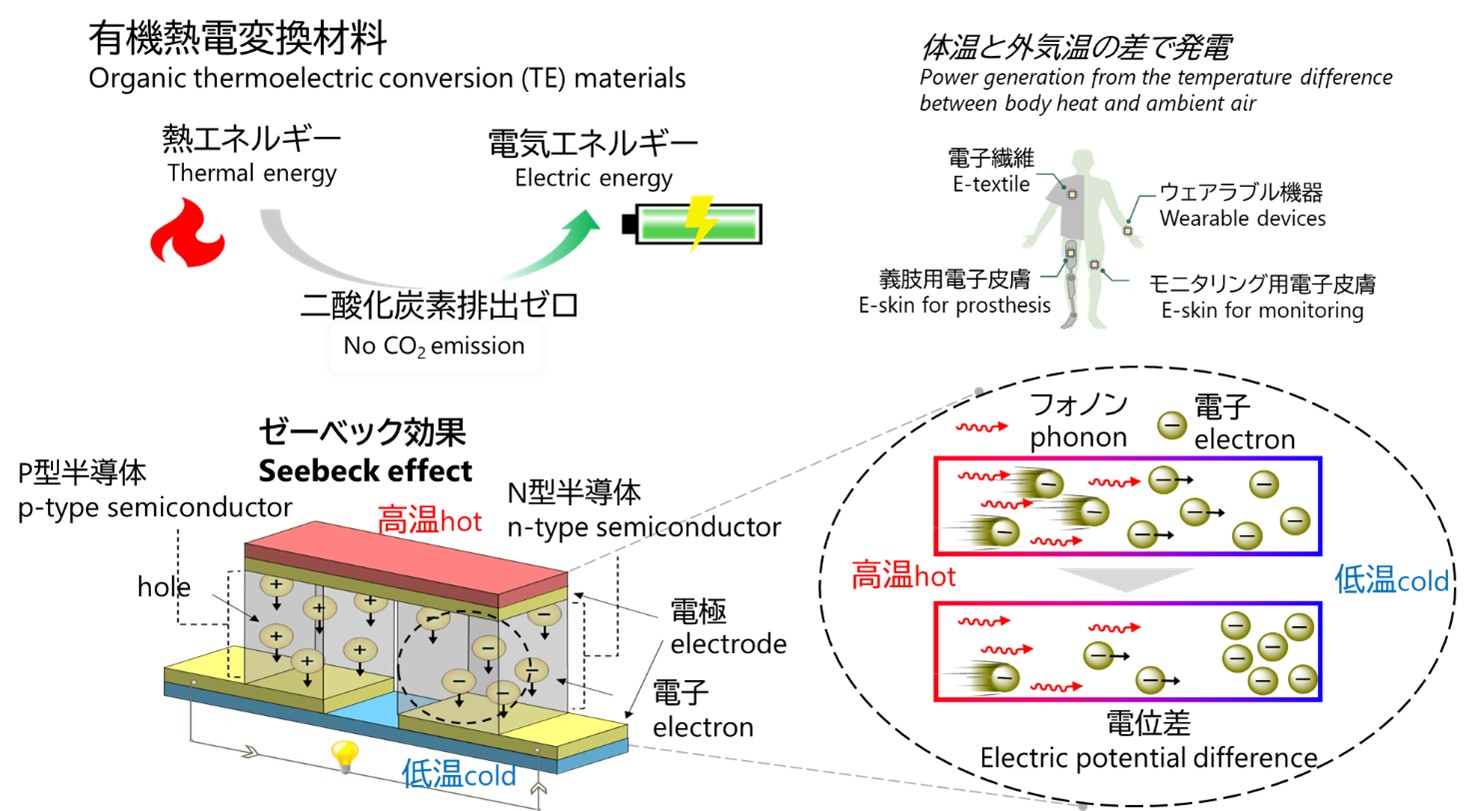
有機熱電変換材料は、温度差を利用して熱エネルギーを直接電気エネルギーへと変換するセーベック効果を利用した機能性材料です。例えば、人体の体温と外気温とのわずかな温度差からでも発電が可能であり、外部電源に依存しないクリーンなエネルギー供給を実現します。また、発電時にCO₂を排出しないことから、持続可能なエネルギー技術として注目されています。従来の無機熱電材料と比較して、有機材料は軽量で柔軟性に優れ、低温プロセスで作製できるという特長を有します。そのため、大面積化や曲面への適用が容易であり、衣服や皮膚に密着するウェアラブルデバイスや電子皮膚(E-skin)への応用に適しています。材料内部では温度勾配に応じて電荷キャリアが高温側から低温側へと拡散し、電位差が生じることで発電が起こります。近年では、分子設計やドーピング技術の進展により、この電荷輸送特性が大きく向上し、有機材料においても実用的な熱電性能が実現されつつあります。本研究室では、π共役高分子の精密設計とナノ構造制御を通じて、「高い電気伝導性」と「低い熱伝導性」という相反する特性の両立を図り、熱電変換効率のさらなる向上を目指しています。これにより、自己発電型センサやフレキシブルエネルギーハーベスティングデバイスの実現に貢献します。
Organic thermoelectric materials are functional materials that directly convert thermal energy into electrical energy using a temperature gradient. Even a small temperature difference between the human body and the ambient environment can generate electricity, enabling clean energy supply without external power sources. In addition, since no CO₂ is emitted during operation, these materials are attracting attention as a sustainable energy technology. Compared with conventional inorganic materials, organic materials are lightweight, flexible, and can be fabricated via low-temperature processes. These features make them suitable for large-area fabrication and integration onto curved surfaces, such as wearable devices and electronic skins (E-skins). Within the material, charge carriers diffuse from the hot side to the cold side along the temperature gradient, generating a potential difference and electrical power. Recent advances in molecular design and doping have significantly improved charge transport, leading to practical thermoelectric performance in organic systems. In our laboratory, we aim to enhance thermoelectric efficiency by balancing high electrical conductivity and low thermal conductivity through precise design of π-conjugated polymers and nanoscale structural control, contributing to self-powered sensors and flexible energy-harvesting devices.
有機薄膜太陽電池材料 Organic Solar Cell Materials
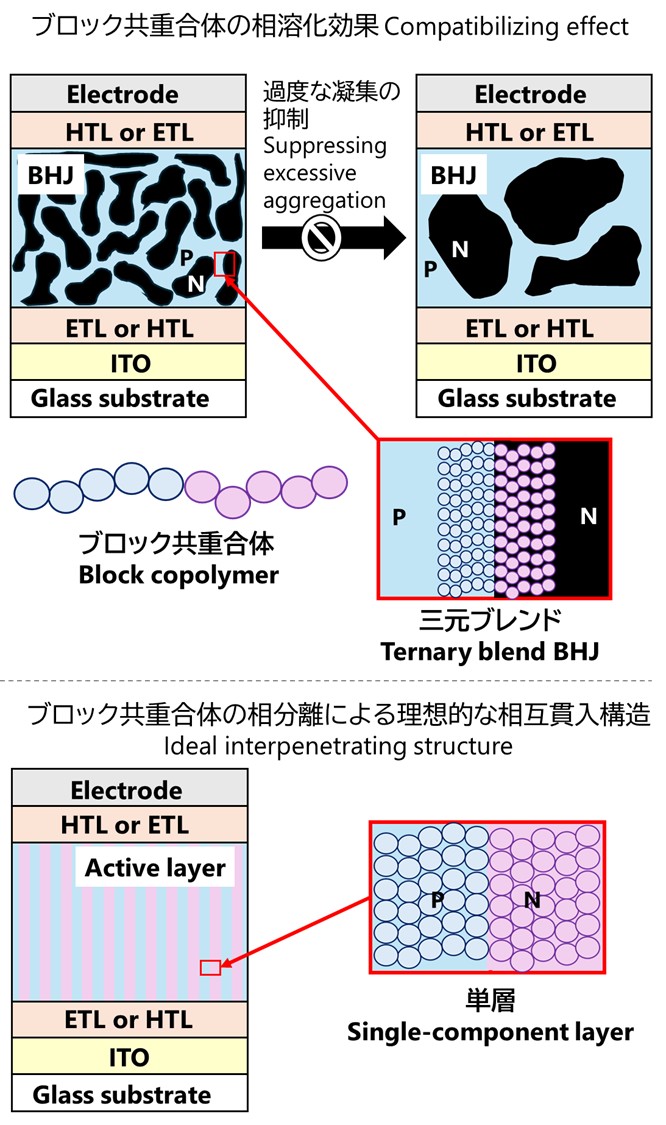
有機薄膜太陽電池は、有機半導体材料を用いて光エネルギーを電気エネルギーに変換する次世代のエネルギーデバイスです。軽量・柔軟で、大面積化や低コスト製造が可能であることから、ウェアラブルデバイスやIoT電源などへの応用が期待されています。一方で、高効率化や長期安定性の向上には、活性層のナノ構造制御が重要な課題となっています。本研究では、これらの課題を解決するために、ブロック共重合体を活用した新しい活性層設計に取り組んでいます。ブロック共重合体は、以下の二つの役割を担う材料として位置づけています。第一に、ドナー(P)材料とアクセプター(N)材料の相溶性を向上させる“相溶化剤”として機能させ、三元ブレンド型バルクヘテロ接合(BHJ)において、より均一で安定な相分離構造を実現します。第二に、ブロック共重合体の自己組織化能を活用し、ナノレベルで秩序だった理想的な相互貫入構造を単層膜として形成させることで、効率的な電荷分離界面と連続的な電荷輸送経路を同時に構築します。このように、ブロック共重合体の分子設計と自己組織化を巧みに利用することで、従来のBHJ構造の限界を超える高性能な有機薄膜太陽電池の実現を目指しています。
Organic thin-film solar cells are next-generation energy devices that convert light into electricity using organic semiconductor materials. Owing to their lightweight, flexibility, and potential for low-cost, large-area fabrication, they are expected to be widely applied in wearable devices and IoT power sources. However, improving power conversion efficiency and long-term stability requires precise control of the nanoscale morphology in the active layer. In this study, we develop a new active-layer design based on block copolymers to address these challenges. Block copolymers are utilized to play two key roles. First, they act as compatibilizers between donor (P) and acceptor (N) materials, enabling a more uniform and stable phase-separated structure in ternary blend bulk heterojunction (BHJ) systems. Second, by exploiting their intrinsic self-assembly capability, block copolymers form well-ordered, nanoscale interpenetrating structures as a single-layer active film. This allows simultaneous realization of efficient charge separation interfaces and continuous charge transport pathways. By integrating molecular design with self-assembly, this approach aims to overcome the limitations of conventional BHJ structures and achieve high-performance organic thin-film solar cells.
高屈折率材料 High Refractive Index Polymer Materials
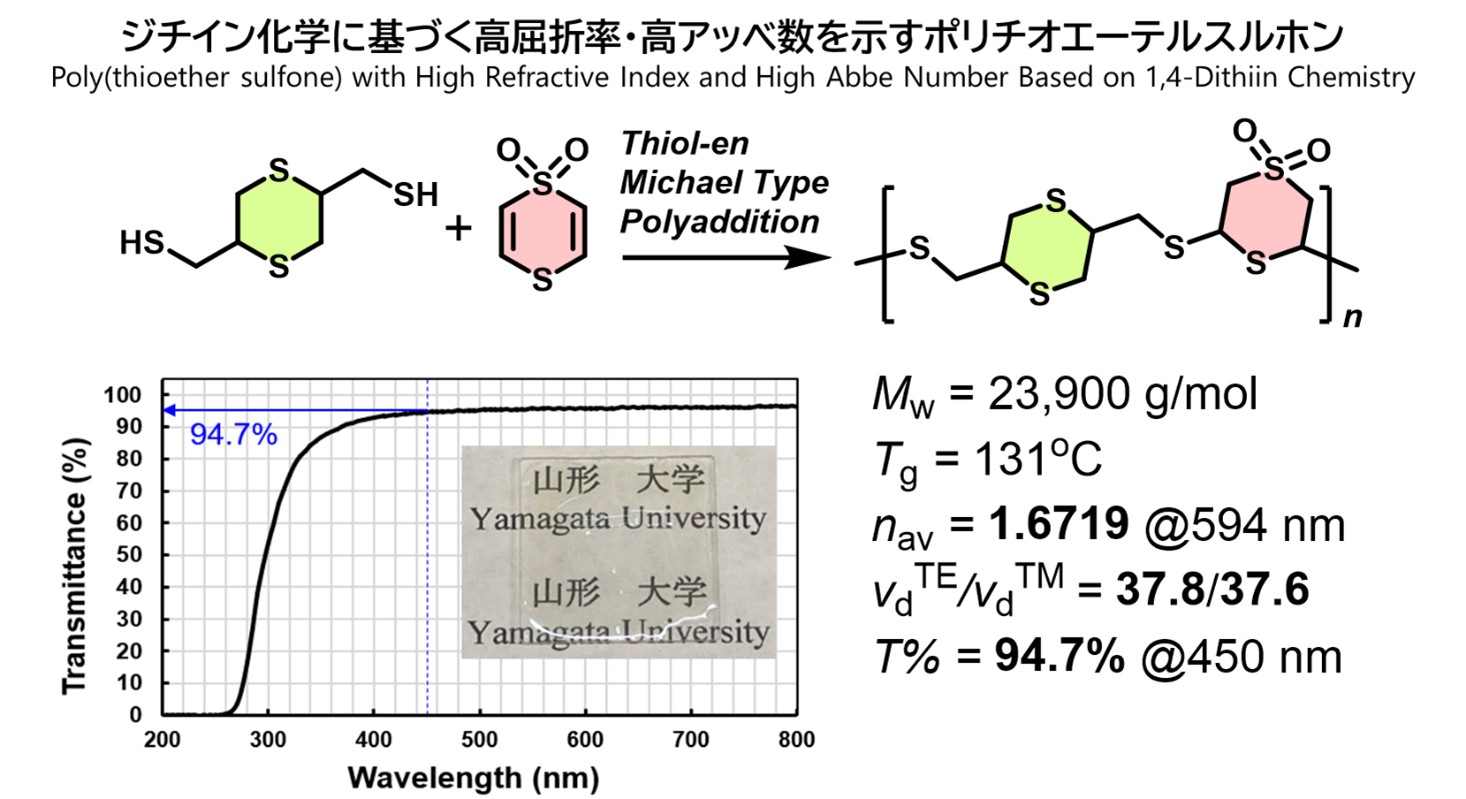
高屈折率材料は、光学レンズ、カメラ・スマートフォン用イメージセンサ、AR/VRデバイス、さらには光導波路やディスプレイ関連技術など、先端光学分野において不可欠な基盤材料です。近年では、デバイスの小型化・高性能化に伴い、より高い屈折率と低色収差(高アッベ数)、さらに高い透明性や耐熱性を兼ね備えた材料への需要が急速に高まっています。本研究室では、こうした市場ニーズに応えるため、有機系高屈折率材料の分子設計に基づいた新規ポリマーの開発を推進しています。特に、硫黄元素を多く含む骨格や脂環構造、スルホン基(–SO2–)を組み合わせることで、「高屈折率」「高アッベ数」「高透明性」「高耐熱性」という、従来はトレードオフ関係にあった物性の両立を目指しています。その代表例として、1,4-ジチイン誘導体を基盤とするポリ(チオエーテルスルホン)を開発しました。本材料は、分子内に高い分極率を有する硫黄元素と、低分散性に寄与する脂環構造を高密度に導入することで、優れた光学特性を発現します。実際に作製したポリマーフィルムは、可視光領域において非常に高い透明性(450 nmで94.7%)を示しつつ、比較的高い屈折率1.67(594 nm)と高いアッベ数(38)を同時に達成しています。このように、本研究では分子レベルでの精密設計により、従来材料の限界を超える高性能光学ポリマーを創出し、次世代の光学デバイス応用への展開を目指しています。
High-refractive-index materials are essential in advanced optical applications such as lenses, image sensors, AR/VR devices, and optical waveguides. With ongoing device miniaturization, demand is rapidly increasing for materials that combine high refractive index, high Abbe number, high transparency, and thermal stability. To address these needs, our laboratory develops novel organic polymers based on molecular design. By incorporating sulfur-rich backbones, alicyclic structures, and sulfone groups (–SO₂–), we aim to overcome traditional trade-offs among these properties. As a representative example, we developed poly(thioether sulfone)s based on 1,4-dithiin derivatives. These polymers exhibit excellent optical performance due to the high polarizability of sulfur atoms and low-dispersion alicyclic structures. The resulting films show high transparency (94.7% at 450 nm), along with a refractive index of 1.67 (594 nm) and an Abbe number of 38, demonstrating the potential of molecular design for next-generation optical materials.
低誘電・低誘電正接材料 Low Dielectric Constant and Low Dielectric Loss Tangent Materials
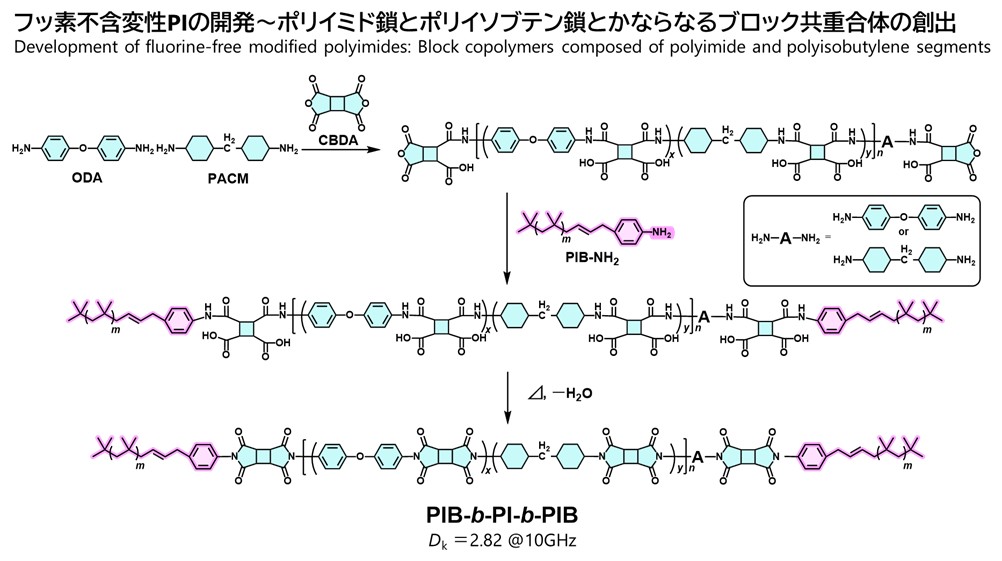
近年、5G/6Gをはじめとする高周波・高速通信技術の進展に伴い、信号伝送の高速化と低損失化を実現するための低誘電率(Dk)および低誘電正接(Df)材料の重要性が高まっています。誘電率の低減は信号伝搬速度の向上に、誘電正接の低減はエネルギー損失の抑制に寄与するため、両者を満たす絶縁材料の開発が求められています。有機高分子材料は軽量性や加工性に優れる一方、分子中の極性基や分極挙動が誘電特性に影響するため、精密な分子設計が重要です。特にポリイミド(PI)は優れた耐熱性や機械特性を有する一方で、比較的高い誘電率が課題であり、極性イミド基の低減、自由体積の増大、非極性構造の導入、分子配向の抑制といった設計が有効です。当研究室では、ポリイミドの骨格を維持しつつ非極性セグメントを導入するブロック共重合体設計に着目し、半脂環式ポリイミド鎖とポリイソブテン(PIB)鎖からなるブロック共重合体を開発しました。本材料では、PIB導入によりイミド基の実効濃度を低減し、分極を抑制することで低誘電化を実現し、10 GHzにおいて誘電率Dk = 2.82と高い耐熱性(5%重量損失温度380 ℃以上)を両立しています。この分子設計はフッ素化に依存しない低誘電材料開発の新たな指針として、高周波通信デバイスなどへの応用が期待されます。
With the rapid advancement of high-frequency communication technologies such as 5G and 6G, low dielectric constant (Dk) and low dielectric loss (Df) materials are essential for fast signal transmission and reduced energy loss. Polymeric materials are attractive due to their light weight and processability, but their dielectric properties are strongly affected by molecular polarity, requiring precise molecular design. Polyimides (PIs), known for their excellent thermal and mechanical properties, generally exhibit relatively high dielectric constants due to their polar imide structures. Effective design strategies include reducing polar group content, increasing free volume, and incorporating nonpolar segments. In our laboratory, we have developed a novel block copolymer consisting of semialicyclic PI and polyisobutene (PIB) segments. The introduction of PIB reduces imide group density and suppresses polarization, achieving a low dielectric constant of Dk = 2.82 at 10 GHz while maintaining high thermal stability (5% weight loss temperature above 380 °C). This approach offers a promising route toward non-fluorinated low-dielectric materials for high-frequency applications.
青果物鮮度保持材料 Freshness-Preserving Materials for Fruits and Vegetables
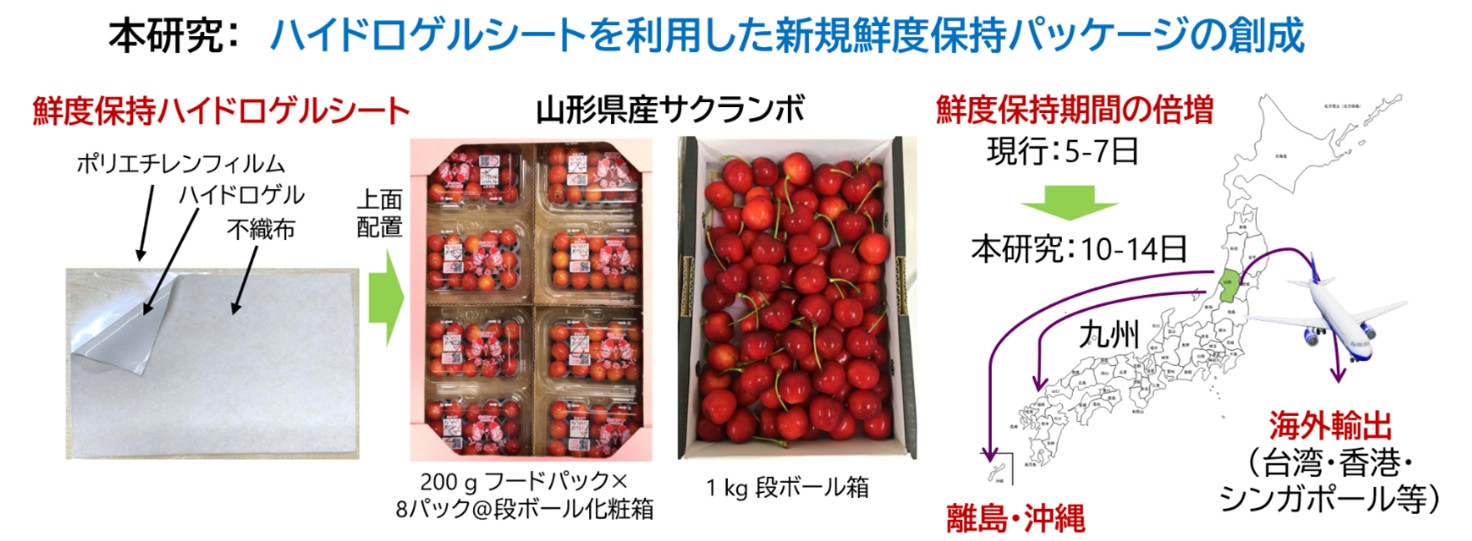
近年、農産物の輸出市場の拡大や高付加価値化の進展に伴い、コールドチェーンおよびスマートパッケージング市場は世界的に成長を続けており、青果物の鮮度を維持した長距離輸送を実現する技術への需要が高まっています。特に輸送中の振動や温度変動、乾燥による品質劣化を抑えるため、温湿度環境を制御する新たな材料が求められています。中でもハイドロゲルは、水の蒸散を利用した湿度供給や温度緩和機能を有する材料として注目されています。当研究室では、オウトウの海外輸送を対象に、ハイドロゲルシートを組み込んだ鮮度保持パッケージを開発しました。本パッケージは段ボール上蓋にゲルシートを配置する簡便な構造で、山形―台湾間の輸送試験において、収穫後約12日でも乾燥に起因する劣化を抑制し、商品価値の維持に有効であることを示しました。今後は、ハイドロゲルシートの低コスト化・高機能化を検討するとともに、将来的には印刷可能で曲げ歪に強い有機エレクトロニクス材料と融合し、RF-IDタグによる輸送情報の可視化と連携したスマートパッケージへの展開が期待されます。鮮度保持と情報機能を統合した次世代パッケージの実現により、農産物流通の高度化に貢献していきます。
In recent years, the expansion of agricultural export markets and the demand for high-value-added products have driven global growth in the cold chain and smart packaging markets, increasing the need for technologies that enable long-distance transportation of fresh produce while maintaining quality. In particular, materials capable of controlling temperature and humidity are required to suppress deterioration caused by vibration, temperature fluctuations, and drying. Hydrogels have attracted attention as promising materials due to their ability to supply moisture and moderate temperature through water evaporation. In our laboratory, we developed a freshness-preserving packaging system incorporating a hydrogel sheet for the overseas transportation of cherries. This simple design places the hydrogel sheet inside the upper lid of a cardboard box and was shown to effectively suppress drying-induced deterioration and maintain product quality even after approximately 12 days post-harvest in transportation tests between Yamagata and Taiwan. Looking ahead, integration with printable and mechanically flexible organic electronic materials is expected to enable smart packaging systems linked with RFID tags for visualizing transportation data, contributing to next-generation agricultural distribution.